
Saint-Tropez history: from Saint Torpès to Signac, Bardot and the Gendarme
The legend of Saint Torpès
Saint-Tropez takes its name from Torpès, a Roman officer at the court of Nero. According to legend, he converted to Christianity and was beheaded in Pisa in the year 68. His body was placed in a boat with a rooster and a dog, and the currents carried it to the shore where Saint-Tropez stands today. Torpès became the town’s patron saint, and over time his name became Tropez.
The Genoese families and the Bravades
After centuries of invasions, the village was destroyed and largely abandoned. In 1470, the baron of Grimaud, Jean de Cossa, signed an agreement with the Genoese nobleman Raphaël de Garezzio, allowing families from Genoa to settle there. They rebuilt the fortifications and took charge of defending the gulf, in exchange for freedom from taxes. The red and white of the Saint-Tropez flag are the colours of the former Republic of Genoa.
This military past is still celebrated every year at the Bravades, held on 16, 17 and 18 May since 1558. Residents parade in period uniforms to honour Saint Torpès and the courage of the town’s defenders.
The citadel
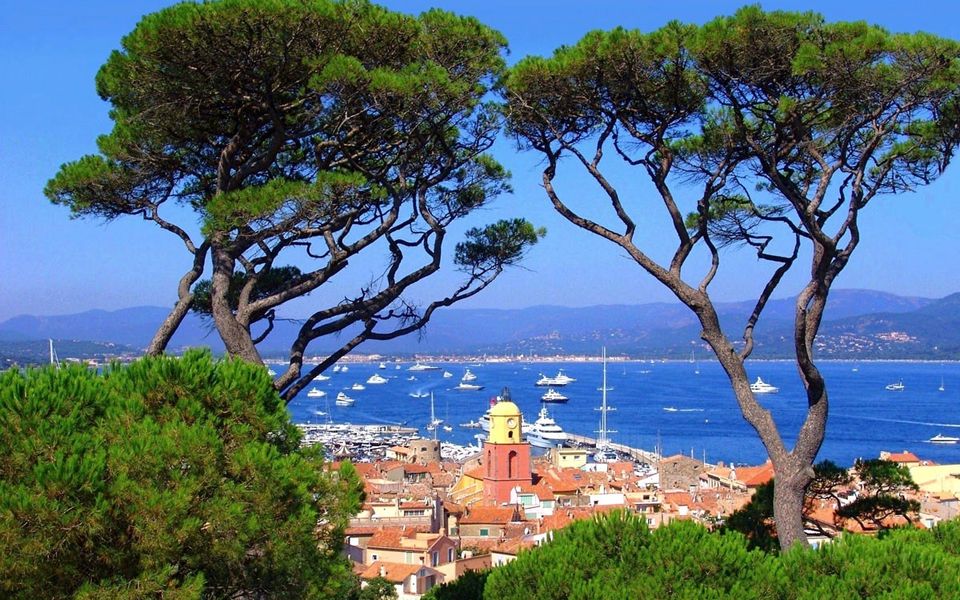
The citadel stands on the hill above the village, overlooking the Gulf of Saint-Tropez. Its hexagonal keep was built between 1602 and 1607. In 1637, the people of Saint-Tropez drove off an attack by around twenty Spanish galleys. The keep now houses the Museum of Maritime History, and the view from the ramparts across the gulf to Sainte-Maxime is remarkable.
A revolutionary name
During the French Revolution, the town was renamed Héraclée, after its ancient name, before later returning to the name Saint-Tropez.
A town of sailors
Pierre André de Suffren, vice-admiral of the royal fleet, came from the family that held the lordship of Saint-Tropez, and his statue stands on the port. In the 19th century, the town built merchant ships, including the three-master La Reine des Anges in 1860, and lived from fishing.
Signac and the painters
In 1892, the painter Paul Signac sailed into Saint-Tropez aboard his yacht, the Olympia. He bought a house, La Hune, made it his studio and invited other painters to join him, including Henri-Edmond Cross, Henri Matisse, André Derain and Albert Marquet. Saint-Tropez became one of the most active centres of avant-garde painting in the early 20th century.
Their work can be seen at the Musée de l’Annonciade, created in 1922 in a former 16th-century chapel on the port. The collection focuses on the Pointillist, Nabi and Fauvist movements.
Colette and the writers
The writer Colette bought a house in Saint-Tropez in 1925, La Treille Muscate, and returned as often as she could. Her friends followed, among them Jean Cocteau, Joseph Kessel and Jean Marais. By 1939, she felt the village had lost its tranquillity, and she left.
The war and the liberation
Saint-Tropez was liberated on 15 August 1944, during the Allied landings in Provence. The port was badly damaged during the war and rebuilt afterwards. Every year, the town commemorates the liberation on 15 August.
The 1950s: Saint-Germain-des-Prés by the sea
In the 1950s, the artists and intellectuals of Saint-Germain-des-Prés in Paris made Saint-Tropez their summer base, with the Hôtel de la Ponche as their headquarters. Françoise Sagan, Juliette Gréco and Boris Vian were among them, and Juliette Gréco went on to live between Paris and Saint-Tropez.
Bardot and the Gendarme
In 1956, Roger Vadim’s film Et Dieu… créa la femme, starring Brigitte Bardot and set in Saint-Tropez, made both the actress and the town famous around the world. In 1964, Le Gendarme de Saint-Tropez, starring Louis de Funès, made the town’s gendarmerie famous. The building has housed the Musée de la Gendarmerie et du Cinéma since 2016.
Saint-Tropez today
Today, Saint-Tropez is one of the best-known villages in the world, yet its history is still part of everyday life: the Bravades in May, the citadel above the rooftops, the paintings of the Annonciade and the port where it all began. For the village as it lives today, read Saint-Tropez day to day.
Further reading
Saint-Tropez day to day: the port, Place des Lices, where to eat and when to go Beaches in Saint-Tropez and Ramatuelle: a guide to the beach clubs of Pampelonne
Explore our collection of luxury villas for rent in Saint-Tropez