
King Leopold II on the French Riviera: Les Cèdres, Villa Leopolda and his estates on Cap Ferrat and Villefranche-sur-Mer
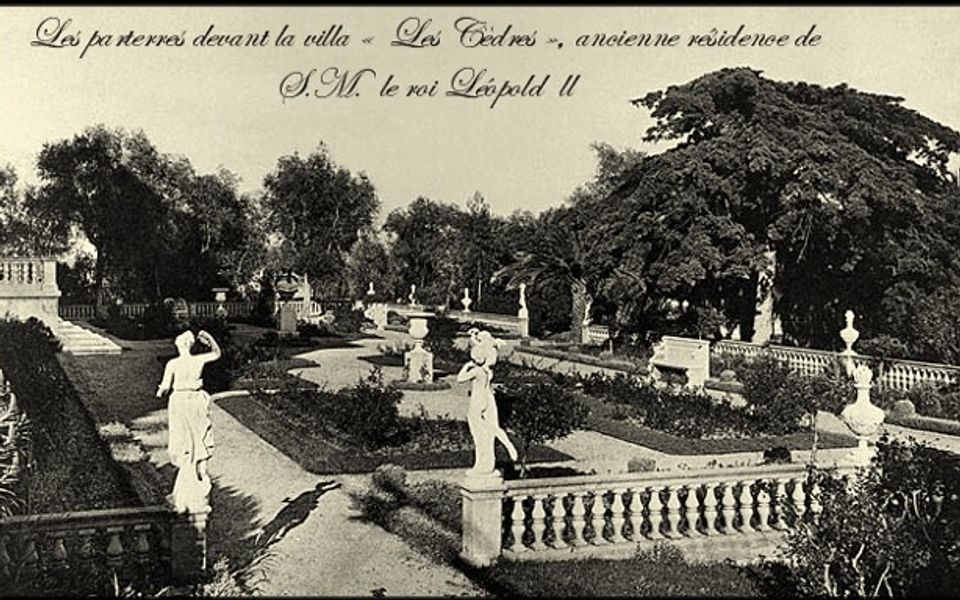
At the turn of the 20th century, King Leopold II of Belgium was one of the largest landowners on the French Riviera. Between Villefranche-sur-Mer and Saint-Jean-Cap-Ferrat, he assembled a remarkable collection of estates, gardens and villas, including Villa Les Cèdres and Villa Leopolda, two of the most famous private properties in the world today.
A king on Cap Ferrat
Leopold II, King of the Belgians from 1865 to 1909, was a regular visitor to the Côte d’Azur, which he often reached by sea aboard his yacht, the Alberta.
From the end of the 1880s, he began buying land on the western side of the Cap Ferrat peninsula, eventually owning around 50 hectares. By 1902 he owned most of the cape. His first purchases included a small property at the port of Passable, later known as the Pavillon des Officiers, where he could come ashore directly from the sea.
Villa Les Cèdres
In 1904, Leopold II bought the estate known as Villa Les Oiseaux from the heirs of David-Désiré Pollonais, the former mayor of Villefranche-sur-Mer, and renamed it Les Cèdres. At the time, the estate covered around 14 hectares, with a ballroom, a winter garden, a chapel and stables.
Until 1908, he combined several neighbouring plots into one estate. The architect Aaron Messiah reworked the façades and some interiors, and a new winter garden, a caretaker’s lodge and modernised stables were added.
From 1905, he had the gardens transformed by Élie Lainé, Jules Vacherot and Harold Peto, the English garden designer who also created the gardens of Villa Maryland. The works included terraced gardens, parterres, pergolas, statues, balustrades, a rose garden, an orangery, a reflecting pool and even a fake ruin.
In 2017, while the villa was on the market, Bloomberg Businessweek published a photo feature taking readers inside Les Cèdres: Look Inside the Most Expensive House on Earth.
Blanche Delacroix
Leopold II installed his young companion, Blanche Delacroix, at Les Cèdres. He had met her in 1899, when she was 16, and she became Baroness Vaughan in 1906. In December 1909, he married her in a religious ceremony five days before his death. The marriage was never recognised by the Belgian court or government.
Villa Leopolda, Villefranche-sur-Mer
In 1902, Leopold II bought several hectares on the heights of Villefranche-sur-Mer, at the Col du Caire. According to one account, he did so after missing out on the Cap Ferrat land that Béatrice Ephrussi de Rothschild bought in 1905, where she later built Villa Ephrussi de Rothschild.
There he built a villa with a central turret, which he named Leopolda, surrounded by gardens laid out by Élie Lainé. The estate was later transformed by the American architect Ogden Codman into the neo-Palladian villa known today. Read its full history in our article on Villa Leopolda.
After the king’s death: a military hospital
When Leopold II died in 1909, his Riviera estates passed to the Belgian state and to his nephew and successor, King Albert I.
During the First World War, as lung disease and tuberculosis spread among soldiers after the gas attacks of 1915, his properties were turned into a Belgian military hospital for around 3,800 soldiers, in two sections: Les Cèdres and the Col du Caire, at Villa Leopolda. The military section of the Saint-Jean-Cap-Ferrat cemetery holds 90 victims of the war.
Les Cèdres after Leopold II
In 1911, the ballroom of Les Cèdres was separated from the estate and became a villa in its own right, later known as Villa Radiana.
In 1924, the estate was bought by Louis-Alexandre Marnier-Lapostolle, owner of the Grand Marnier liqueur. His family turned the grounds into one of the world’s most important private botanical gardens, with around 25 heated greenhouses and some 14,000 tropical species. Bitter orange trees linked to Grand Marnier were also grown there.
The estate remained with the Marnier-Lapostolle company until 2016, and in 2021 the park, greenhouses, statuary and chapel were partly listed as historic monuments.
Villa Radiana: the ballroom of Les Cèdres
Around 1906, Leopold II added a function pavilion to the Les Cèdres estate, on the chemin de Passable overlooking the Passable bay. It was designed by the Paris architect Honoré Daumet and the Nice architect Aaron Messiah, and was inspired by the Belvédère in the gardens of the Petit Trianon at Versailles. The interiors were decorated by the Paris firm Despouy, and a gilded metal chandelier in the rotunda is said to have belonged to Leopold II himself.
After the king’s death, the Les Cèdres estate was divided and sold in parts, and the ballroom became a private residence in its own right. It was known as Villa Le Casin in the 1920s, then as Villa Radiana from the 1930s. The villa is said to appear in Alfred Hitchcock’s 1955 film To Catch a Thief, starring Cary Grant and Grace Kelly. It was later redesigned by the Nice architect Philippe Mialon, but it has kept its rotunda and the character of the original pavilion. Read its full history in our article on Villa Radiana.
Leopold II’s legacy on the Riviera
More than a century later, Leopold II’s influence can still be seen between Villefranche-sur-Mer and Cap Ferrat, from the avenue Léopold II in Villefranche to the gardens of Les Cèdres and the grounds of Villa Leopolda. The estates he assembled are among the most valuable on the Riviera today.
This article was written purely out of historical interest. None of the properties mentioned are real estate listings.
Discover all our luxury villas for rent in Saint-Jean-Cap-Ferrat